Stories and guides for a more thoughtful Alaska trip.
Crafted by Mary Jacquel, from lived experience, original photography, and practical insight.
Alaska’s Grandeur and Magnificence: Tiny Humans in a Vast, Wild Place
A quiet story about why I’m drawn to tiny humans in big Alaska places—and how that turned into a limited edition fine art print collection: Alaska’s Grandeur and Magnificence.
There are days in Alaska when the land feels almost reasonable in size.
You walk a familiar trail, sip your tea, watch the clouds move over the ridge you know by heart. The scale feels…manageable.
And then there are days when Alaska reminds you who’s really in charge.
A glacier looms larger than the mind can hold. A mountain range stacks itself into layer after layer until it fades into air. A small cabin disappears beneath peaks that have been here longer than any of us can remember.
Those are the moments that live inside this new fine art print collection: Alaska’s Grandeur and Magnificence — nine Alaska landscape photographs where humans, cabins, and seals become tiny markers inside something impossibly vast.
This is the kind of Alaska wall art I reach for when I need to remember my size in the best way.
Why I Photograph Tiny Humans in Big Places
As an Alaska photographer, I spend a lot of time pointing my lens at what most people would call “the main event” — the glacier face, the mountain, the waterfall, the whale.
But the frames I come back to again and again have something else in them:
a single person in a yellow coat, a small cabin under a massive peak, two seals on a drifting piece of ice.
Those smaller shapes do two things at once:
They reveal the true scale of glaciers and mountains in a way our minds can finally measure.
They remind us how small we are — not in a diminishing way, but in a freeing, perspective-giving way.
When I look at these Alaska landscape photos, I feel the same thing in my body that I feel standing on the shoreline: awe, humility, and a little bit of quiet relief. The world is big. I don’t have to hold it all.
That feeling is what I wanted to gather on paper.
A Few Moments Inside the Collection
Each print in Alaska’s Grandeur and Magnificence was chosen because it tells a slightly different story about scale. Here are three of them.
Tiny on the Mendenhall
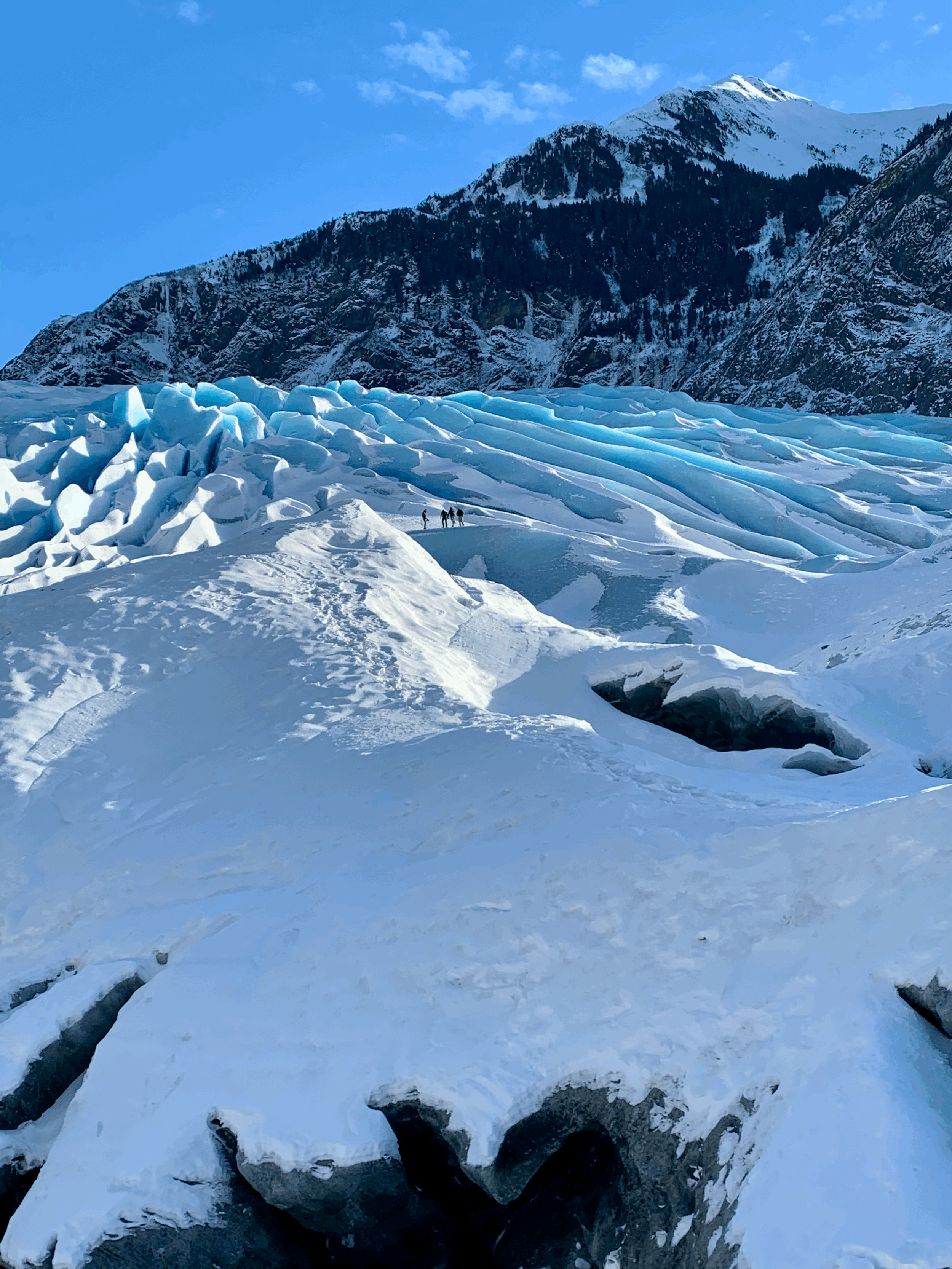
Image: people standing on Mendenhall Glacier
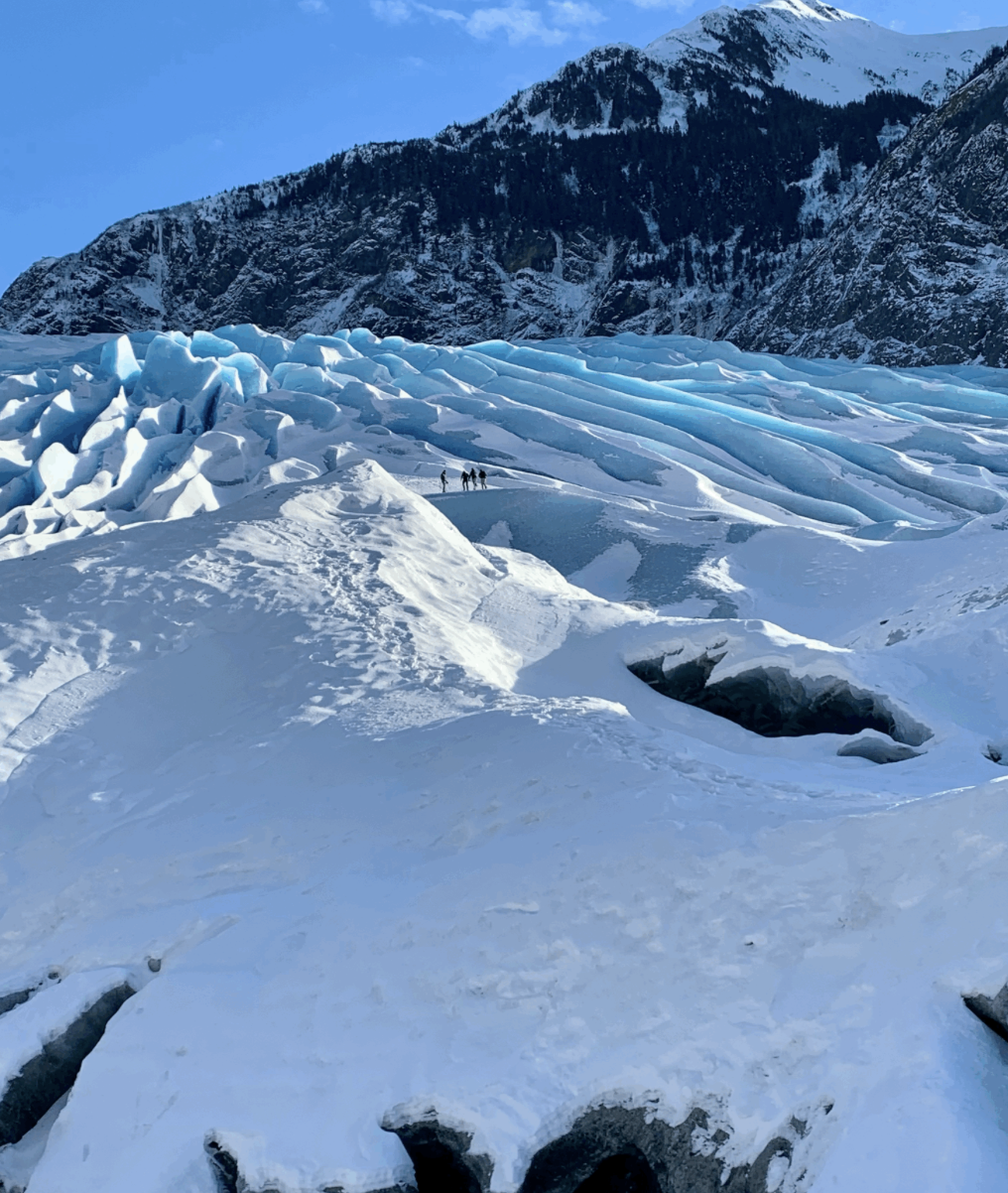
In this photograph, four tiny figures stand on Mendenhall Glacier in Juneau, Alaska. At first glance you might miss them, swallowed by blue and white. Once you see them, the glacier suddenly grows to its actual size in your mind.
This is one of my favorite glacier wall art images because it pulls the viewer in twice: first for the ice, then for the humans. It feels like standing there all over again — a brief moment of being held by something ancient.
Cabin Under Giants
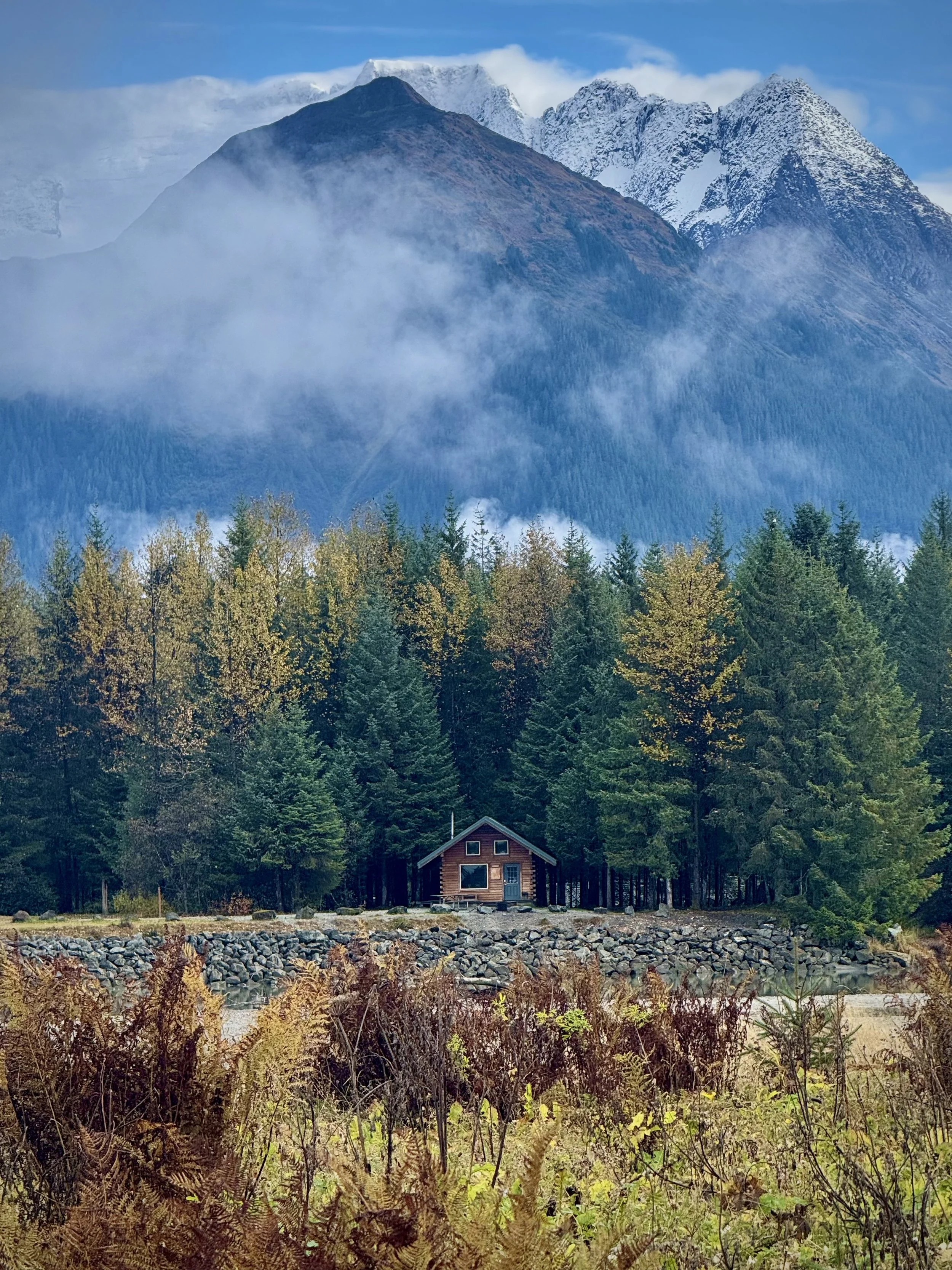
Image: small cabin with mountains rising behind it
Far below the ridgeline, a small cabin tucks itself into the forest. If you cropped the mountains out, the cabin would look solid and self-contained. But with those peaks behind it, you see the truth: this is a tiny, cozy place in a very big world.
This is the Alaska mountain print I imagine hanging in a living room or office where someone needs a reminder that it’s okay to retreat and be small, even when life feels huge.
Drifters on the Blue
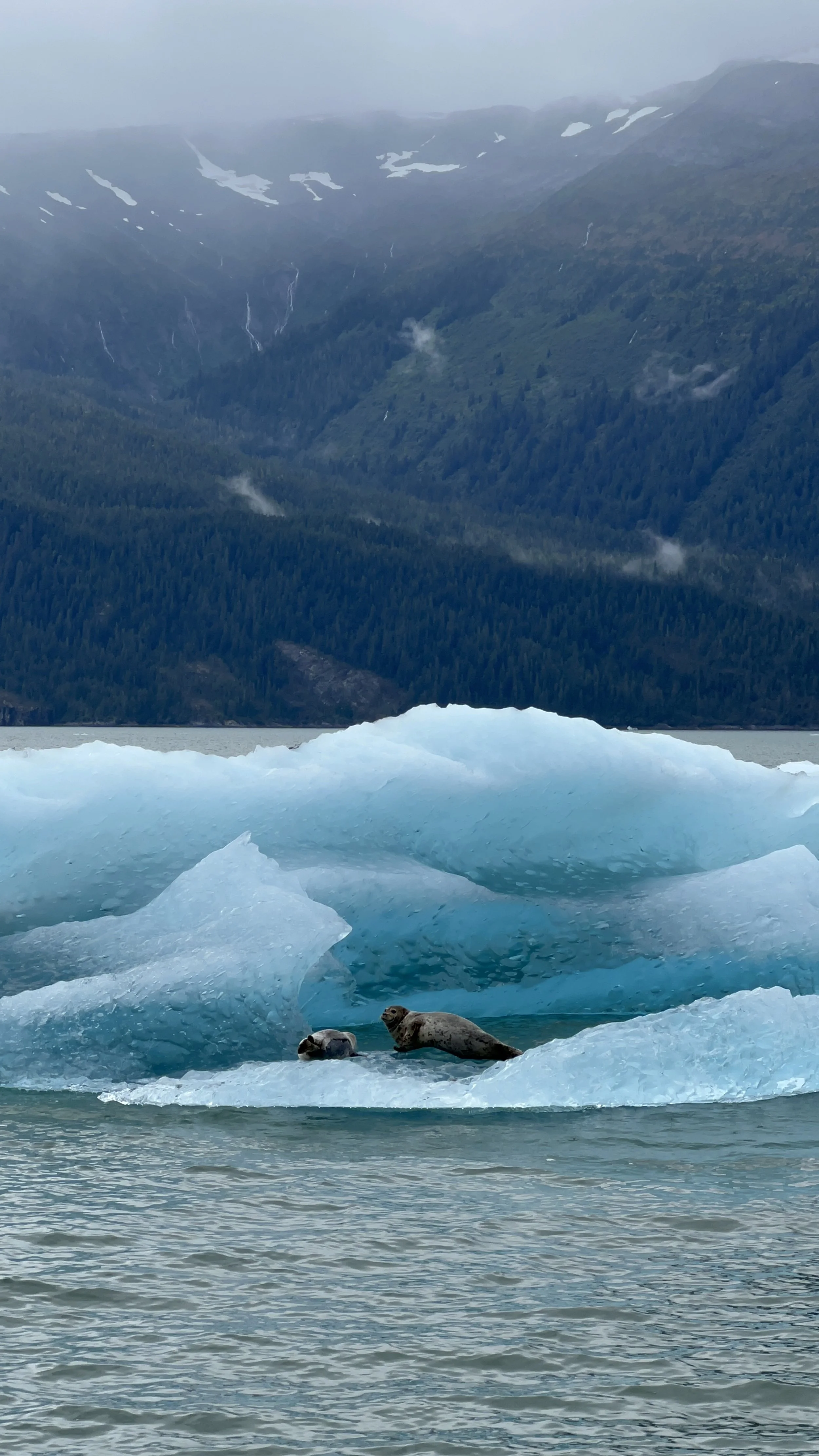
Image: two seals on ice with mountains in the distance
On a quiet day, two seals rest on a floating chunk of glacier ice, carried along by cold water and hidden currents. The mountains behind them, the depth of the channel below, the history locked inside that ice — all of it dwarfs their little resting place.
This is one of those Alaska wildlife moments that doesn’t shout. It’s not a breach or a dramatic splash. It’s a soft exhale on a drifting platform, a small pause inside an enormous system.
How I Hope These Prints Feel in Your Space
When I imagine these pieces hanging in someone’s home, I don’t imagine a gallery or a perfectly styled room.
I imagine:
A mug of tea on the table beneath a glacier print.
A child asking, “Are those people really that small?”
Someone working through a full, loud day and glancing up at a cabin tucked under mountains, remembering that they can set down what they’re carrying for a moment.
These limited-edition Alaska fine art prints are meant to be daily reminders of perspective:
That there is a world outside the to-do list.
That we are small in the best way.
That wild places still exist and are worth paying attention to.
Each image in the Alaska’s Grandeur and Magnificence collection is printed on archival fine art paper, signed and numbered in limited editions, and available in two sizes so you can choose the scale that fits your space — whether it’s a small corner or a statement wall.
Explore the Alaska’s Grandeur and Magnificence Collection
If you’ve ever stood on the deck of a ship, a shoreline, or a trail in Alaska and felt yourself shrink (in that good, grounding way), this collection was made with you in mind.
You can see all nine images — glaciers, mountains, cabins, waterfalls, and those tiny markers of human and animal life inside them — here:
Explore Alaska’s Grandeur and Magnificence – Limited Edition Alaska Prints
Whether one of these scenes ends up on your wall or you simply pause for a quiet moment with them on the screen, I hope they give you what Alaska always gives me: a deep breath, a sense of awe, and the reminder that you are part of something vast and beautiful.
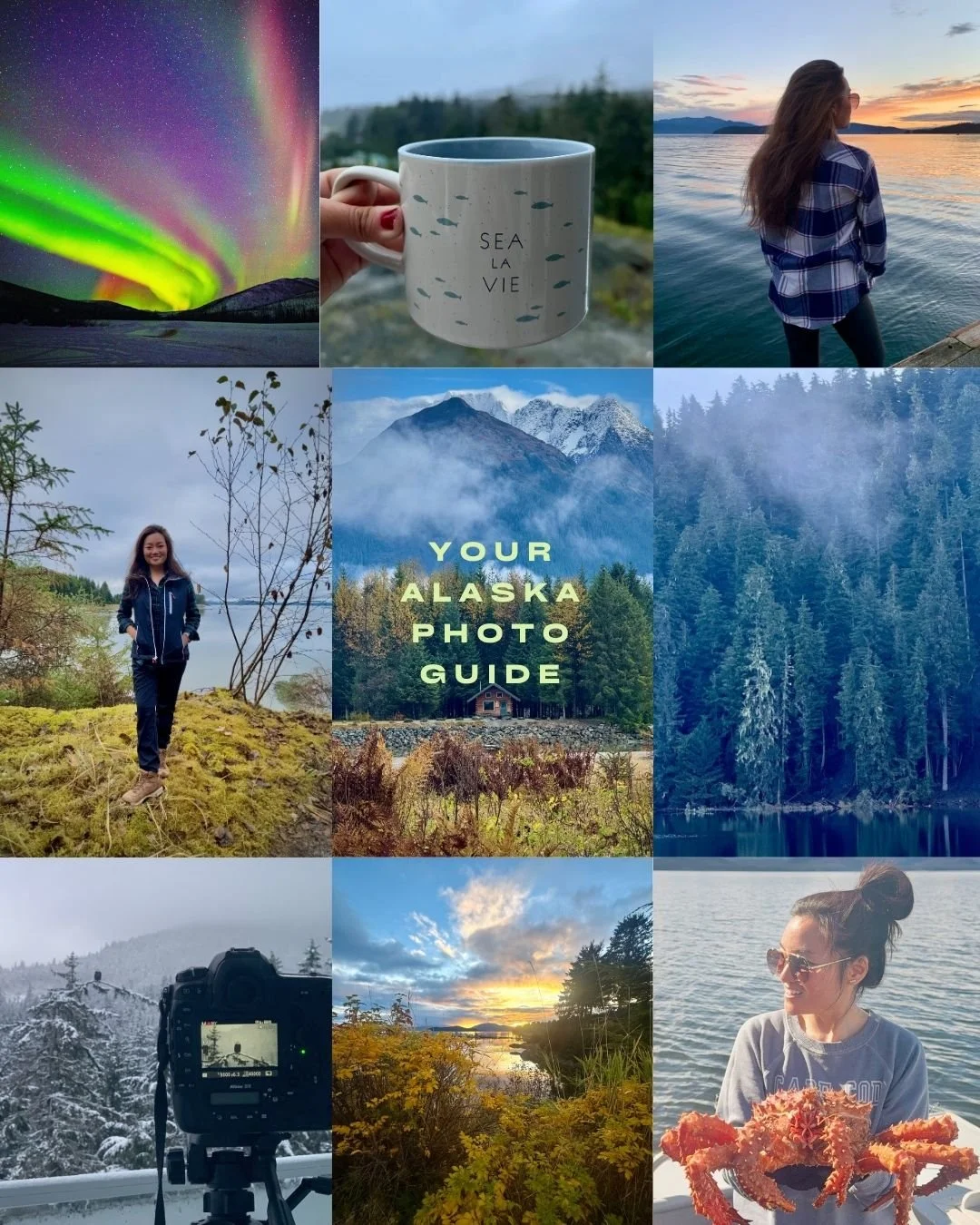
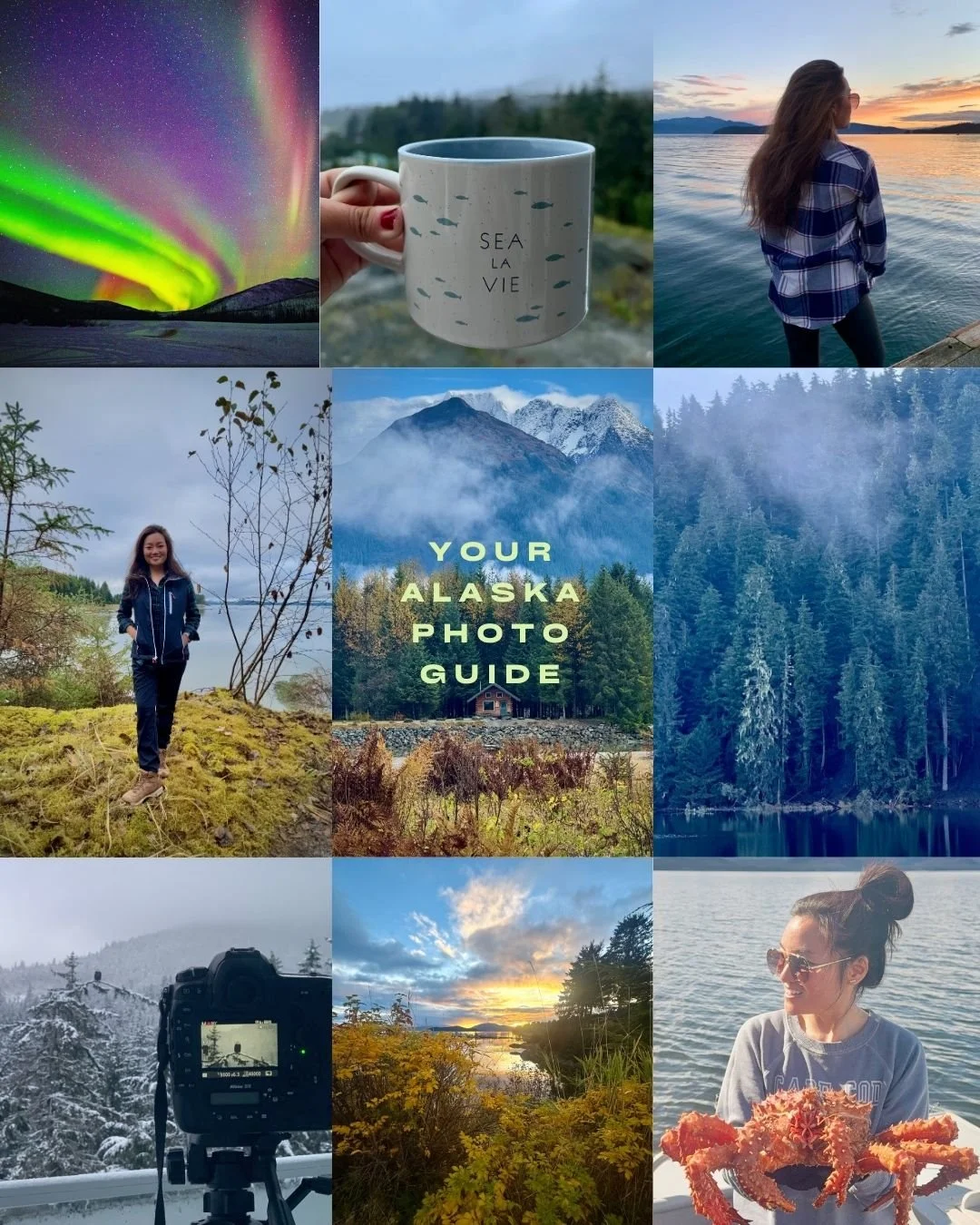
Alaska Cruise Photography Guide: 12 Shots To Consider (And How to Capture Them)
Local Juneau photographer shares 12 must-have Alaska cruise photos—whales, glaciers, ports, and quiet deck moments—plus simple tips for phone and camera.
Hi, I’m Mary — a photographer living in Juneau, Alaska, who spends a lot of time watching ships glide into port, listening for whale blows, and chasing light around mountains, harbors, and rain-soaked streets.

From my deck, I can almost always tell who’s “ready” for Alaska and who isn’t. Not because of gear, but because of attention. The people who come home with photos they truly love aren’t always the ones with the nicest camera. They’re the ones who are paying attention when the light shifts, when the fog lifts, when a whale’s tail appears where there was just empty water a second ago.
This guide is your simple, stress-free shot list: 12 photos you’ll be glad you captured on your Alaska cruise — plus easy tips for getting them, whether you’re using a phone or a camera.
The 12 Photos You Don’t Want to Miss
Here’s the quick list. If you capture nothing else, aim for these:
1. Your ship sailing into Southeast Alaska in soft morning or evening light
2. A wide shot of glacier ice with something for scale (your ship, a boat, or a person)
3. A whale’s tail or breach from deck or a small-boat tour
4. A bald eagle — in flight, perched, or silhouetted against mountains
5. Rainy-day reflections in a port town street (Juneau, Ketchikan, Sitka, etc.)
6. A working harbor scene: boats, docks, mist, and all
7. A “tiny human, big landscape” shot at a waterfall or viewpoint
8. A quiet moment on deck: you, a blanket, and the horizon
9. Layers of mountains and islands in the Inside Passage at dusk
10. A night shot from the ship: city lights, harbor, or stars
11. A detail that feels uniquely yours (boots, journal, tea, map, hands on the railing)
12. A farewell shot to your favorite port or your final sea day
The rest of this post walks you through where, when, and how to capture each one — without turning your vacation into a full-time photo shoot.
Your Ship Sailing Into Alaska Light
Why it matters:
There’s a quiet magic to the way your ship slips into Southeast Alaska — low clouds, soft light on the water, maybe a single fishing boat passing by. It sets the tone for your whole trip.
Where / when:
• Early morning or early evening as you approach Alaska or sail through narrow channels
• Look for gentle color in the sky — blues, pinks, soft grays
How to capture it:
• Phone: Wipe your lens (ship decks get misty), tap to focus on the horizon, and slightly lower your exposure if the sky feels too bright.
• Camera: Use a wider lens (24–35mm range) and keep your shutter speed fast enough to handle ship movement (1/250 or faster).
Extra tip:
Include the ship’s railing or a bit of deck in the frame so you remember what it felt like to stand there, not just what it looked like.
2. Glacier Ice With a Sense of Scale
Why it matters:
Glaciers are enormous, but photos can flatten them. Adding scale helps you remember just how massive that wall of ice really was.
Where / when:
• Glacier days: places like Glacier Bay or Tracy Arm, or a glacier-viewing excursion
• When the captain slows the ship or turns for viewing
How to capture it:
• Look for something small against the glacier:
• A tiny sightseeing boat
• The bow of your own ship
• A person on a viewing deck or trail
• Compose wide first, then grab a few closer shots of details (cracks, blue ice, calving if you’re lucky).
Extra tip:
Stay patient. The scene changes every few seconds as the ship turns. Sometimes the best angle is two minutes after everyone else went back inside.
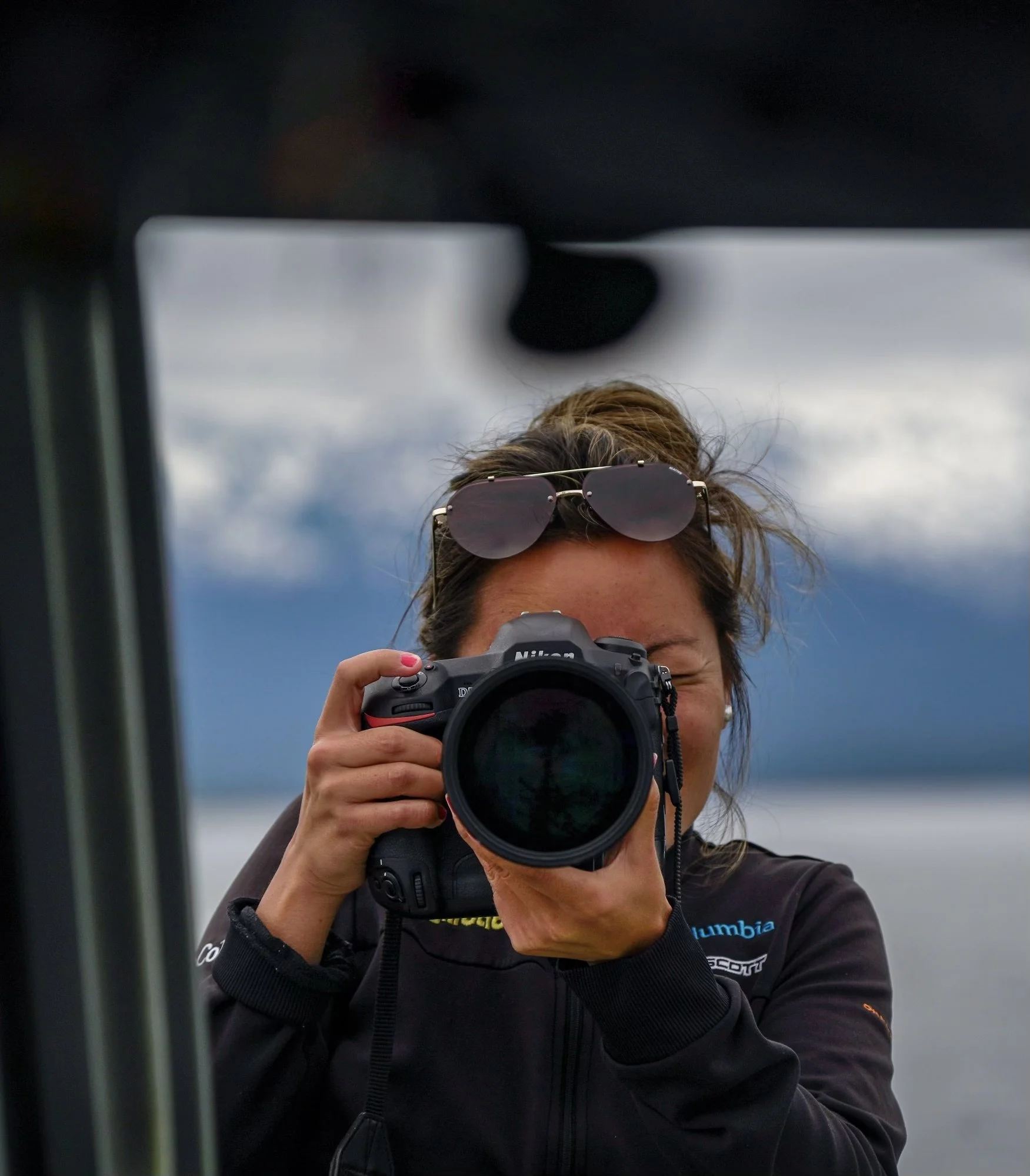
3. Whale Tail or Breach
Why it matters:
If you see whales on your trip, those moments will live in your memory long after your suitcase is unpacked. The goal isn’t a perfect magazine shot — it’s a photo that brings you back to the feeling.
Where / when:
• On deck in calm waters
• Dedicated whale-watching excursions out of ports like Juneau or Icy Strait
How to capture it:
• Phone: Shoot video when whales are active. You can pull still frames later.
• Camera: Use your longest lens and a fast shutter (1/1000 or faster). Continuous focus and burst mode help.
• Keep both eyes open when you can; whales often surface where people aren’t pointing.
Extra tip:
Take one photo of your surroundings too — the boat, the mountains, the people watching. That context is part of the story.
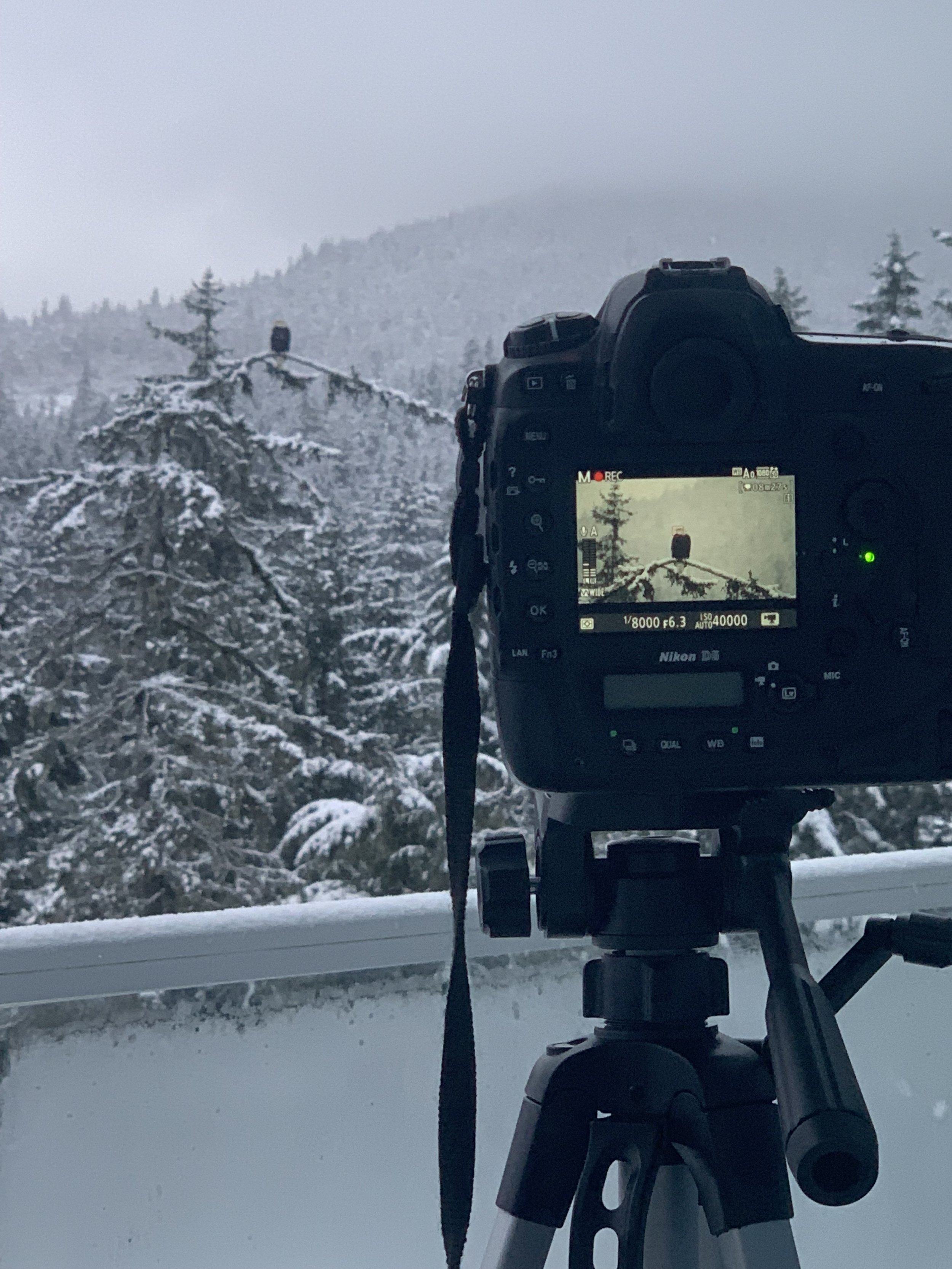
Photographing eagle in Alaska
4. Bald Eagle in Its Element
Why it matters:
Eagles are woven into the everyday here. Capturing one in a tree, on a lamppost, or cruising over a harbor gives your gallery a sense of place.
Where / when:
• Harbor areas, light poles by the ship, tall trees near town
• Early morning or late day when they’re often more active
How to capture it:
• Start with a wider shot: eagle plus its surroundings. Then zoom or crop in.
• Don’t stress about perfection. Even a slightly distant eagle feels special when you know you were really there.
Extra tip:
Look up when you hear gulls calling loudly in one spot — often an eagle is nearby.
5. Rainy-Day Reflections in Port
Why it matters:
Alaska isn’t just blue skies and postcard sunsets. The rain is part of the experience — and it can make beautiful, moody photos.
Where / when:
• Any rainy port day (Juneau, Ketchikan, Sitka, etc.)
• Puddles, wet boardwalks, reflections in shop windows
How to capture it:
• Aim your camera or phone down: reflections of neon signs, colorful buildings, umbrellas.
• Look for one bright color (a jacket, a storefront) against all the grays and greens.
Extra tip:
Use your hood or hand to shield your lens from raindrops. One drop on the lens can soften the whole frame.
6. Working Harbor Scenes
Why it matters:
The working side of Alaska — fishing boats, tugs, docks, gear — tells as much of the story as the mountains do.
Where / when:
• Harbors near the cruise docks or a short walk away
• Early morning or later evening when boats are coming and going
How to capture it:
• Step back and look for layers: boats, docks, water, forest, clouds.
• Let lines lead the eye: docks, ropes, rails.
• Don’t be afraid of “busy” scenes; that’s the point.
Extra tip:
Take one frame that’s a little wider than you think you need. You’ll appreciate the extra breathing room when you look back later.
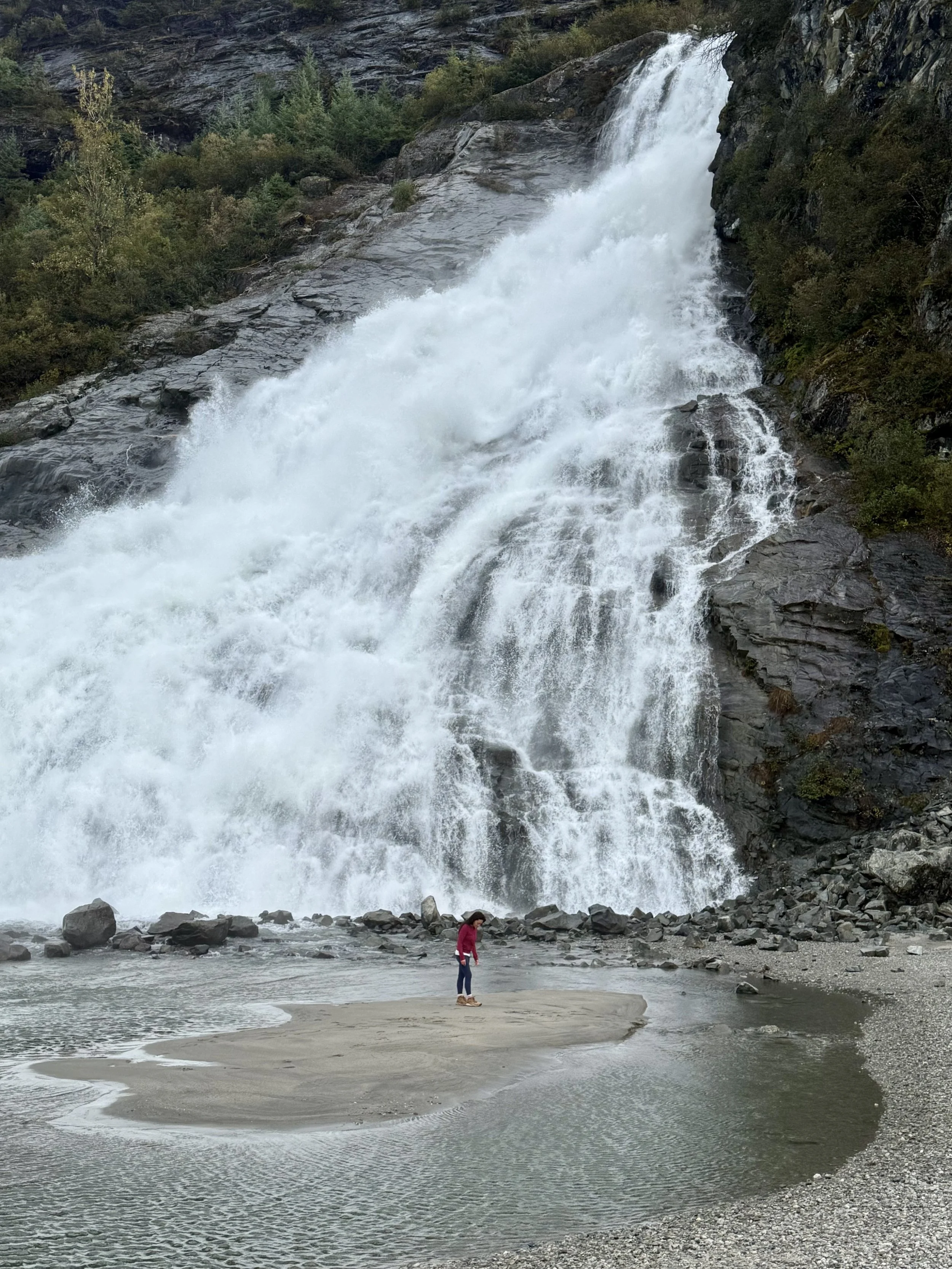
7. Tiny Human, Big Landscape
Why it matters:
Having a person in the frame lets you feel just how big Alaska really is. It also makes the photo deeply personal: you were there.
Where / when:
• Waterfall trails (like Nugget Falls at Mendenhall)
• Viewpoints, shoreline stops, train overlooks, and pullouts on excursions
How to capture it:
• Ask a travel partner to stand still for a few seconds at a safe spot.
• Compose so the person is relatively small in the frame compared to the landscape.
• Use a wider lens or step farther back.
Extra tip:
If you’re traveling solo, use a railing, rock, or backpack as a tripod and turn on the timer. You deserve to be in your own story.
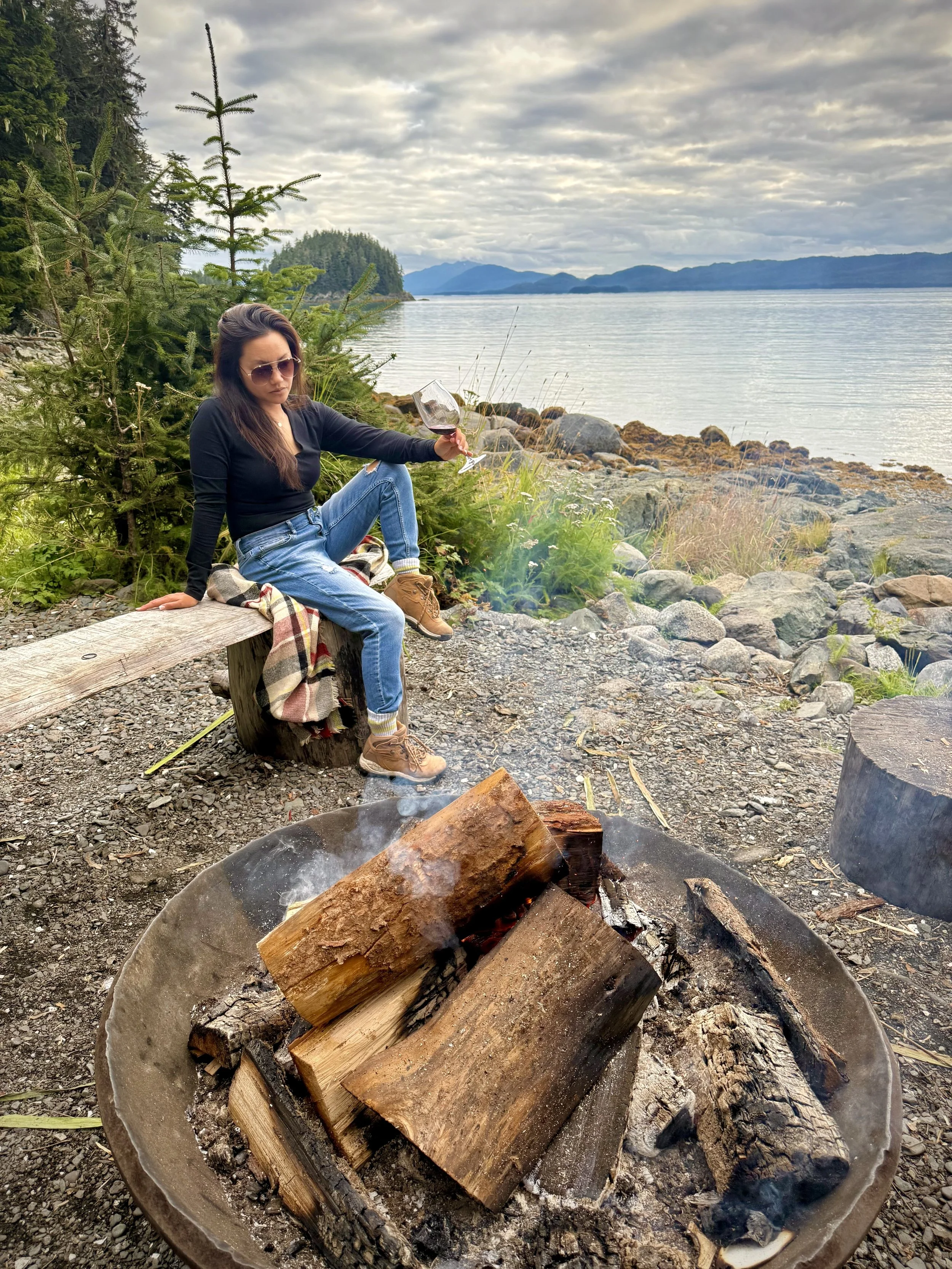
8. Quiet Moment on Deck: Tea, Blanket, Horizon
Why it matters:
Some of the most powerful images aren’t the grandest. It might be you wrapped in a blanket watching the shoreline with a mug of something warm. That’s Alaska too.
Where / when:
• Early mornings when the decks are quiet
• Late evenings when the sky softens and the ship hums
How to capture it:
• Set your drink, journal, or hands on a table or railing and compose around that.
• Include a hint of sea or coastline so you remember where you were.
Extra tip:
If you’re a tea person, pack a favorite Alaska-inspired tea and give yourself one “slow photo moment” like this each day. The photo becomes a visual anchor for how you wanted this trip to feel.
9. Inside Passage Layers at Dusk
Why it matters:
The Inside Passage often shows up as overlapping layers of mountains and islands fading into the distance. It’s one of the most quietly beautiful scenes of the cruise.
Where / when:
• Evenings on sea days as you sail between ports
• Look out toward the land where the mountains stack on each other
How to capture it:
• Use a slightly longer focal length if you have it (50–70mm) to compress the layers.
• Slightly lower your exposure so the sky doesn’t wash out.
Extra tip:
These scenes change every minute. Stay outside a little longer than you think you need; the best frame might be five minutes after you were ready to go in.
10. Night Shot: Harbor, City Lights, or Stars
Why it matters:
Nights on a ship are a whole different mood — the quiet of the decks, city lights reflecting on the water, or a dark sky far from shore.
Where / when:
• Evenings in port (city lights and harbor)
• Sea days when the sky is clear enough for stars
How to capture it:
• Phone: Use night mode and brace your elbows on the railing or a solid surface. Hold still as your phone gathers light.
• Camera: Use a slower shutter and higher ISO, and brace against something solid or use a mini tripod.
Extra tip:
Even if you don’t get a “perfect” pin-sharp shot, the atmosphere itself — a bit of blur, a little grain — can feel exactly like the memory.
11. Your Personal Detail: The Story Only You Can Tell
Why it matters:
Not every meaningful photo has a mountain in it. Sometimes it’s your rain boots by the door, your partner’s hand around a mug, your journal open next to a map.
Where / when:
• In your cabin
• On a bench in port
• On deck while you wait for sailaway
How to capture it:
• Look down: boots, hands, teacup, notebook, a pressed leaf, a ticket stub.
• Compose simply. Let that one detail fill most of the frame.
Extra tip:
Try taking one “detail photo” every day of your cruise. Later, those are often the images that unlock the feelings you can’t quite put into words.
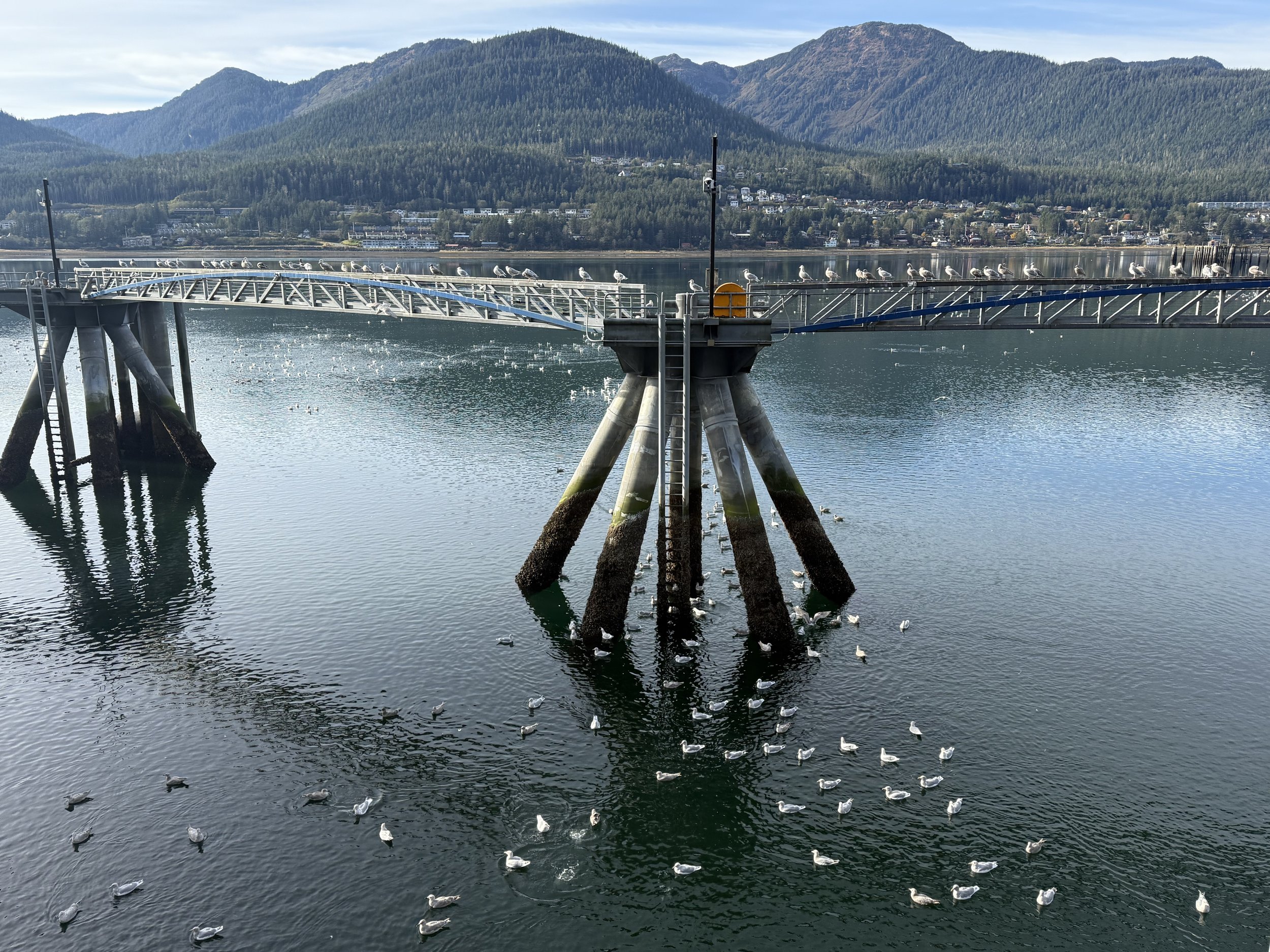
Juneau Cruise Dock
12. Farewell Shot: Last Port or Final Sea Day
Why it matters:
The end of a trip can feel bittersweet. A farewell photo is a way of saying “thank you” to the place that held you for a week.
Where / when:
• As your ship pulls away from your last Alaska port
• During your final sea day in the Inside Passage
How to capture it:
• Turn back toward the land and take one last wide shot.
• Or photograph your own feet on deck, with the wake trailing off behind you.
Extra tip:
Think of this as closing the visual loop — the last image in the story you started when you first sailed into Alaska light.
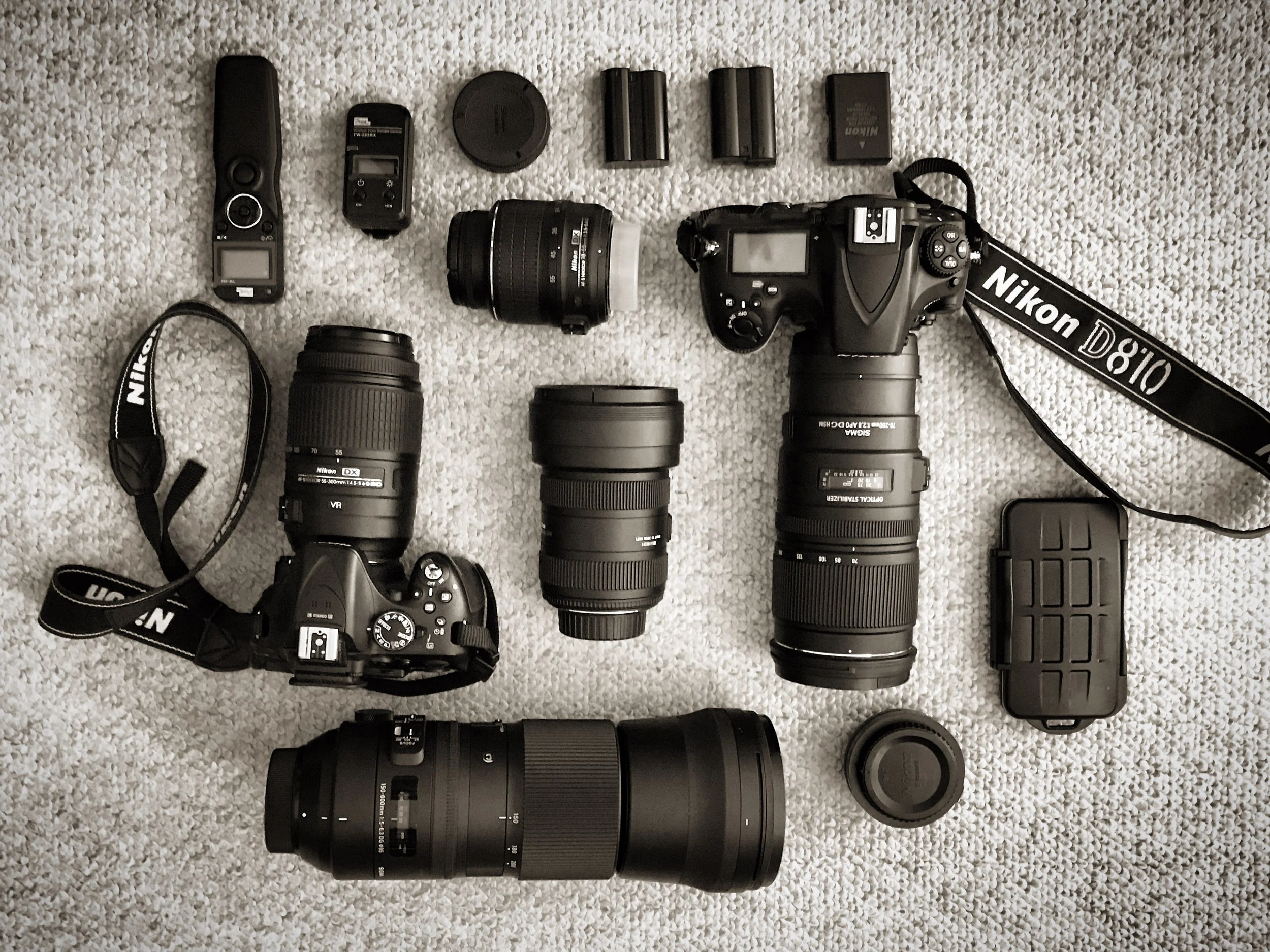
Simple Gear Tips (Even If You’re Only Using a Phone)
You don’t need a huge camera bag to come home with photos you love. A few simple choices go a long way.
If you’re using a phone:
• Wipe the lens often
• Learn how to:
• Tap to focus
• Adjust exposure slightly darker for bright skies and ice
• Use video for fast-moving moments (whales, eagles) and pull still frames later
If you’re bringing a camera:
• One wide-to-mid zoom (something like 24–70mm or 24–105mm)
• One longer lens if you care about whales and eagles
• Extra battery and memory card
• A soft cloth to deal with mist and spray
For everyone:
• Small daypack or dry bag
• Lightweight gloves you can still use to press buttons
• A way to keep your gear dry when it rains (plastic bag, rain cover, or even a spare buff)
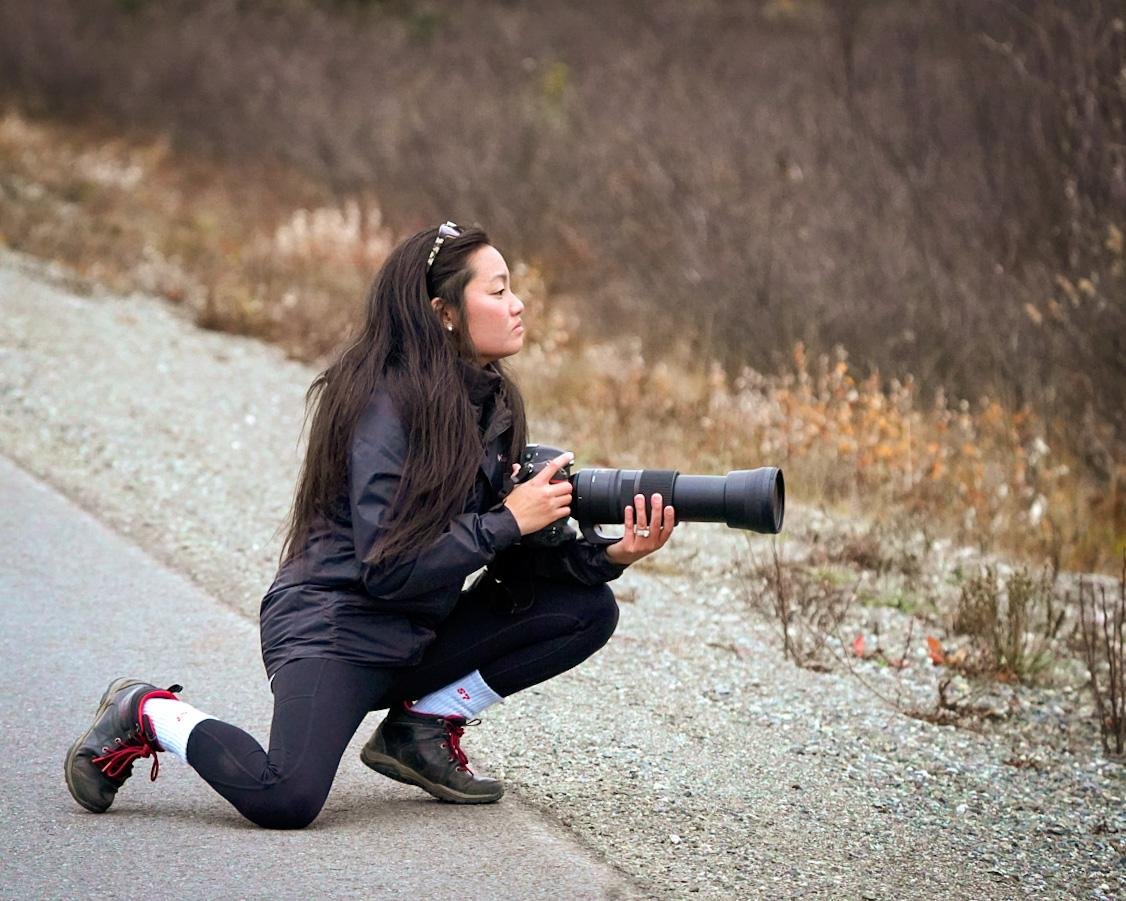
Photographing moose in Denali National Park
How to Stay Present While Still Getting Great Photos
The biggest mistake I hear from travelers is their frustration when they are trying to capture everything and missing how it feels to be here.
A few gentle rules you might try:
• Give yourself one or two “photo goals” per day from this list instead of chasing all twelve at once.
• When you arrive somewhere beautiful, look for 30 seconds before you lift your camera. Let your senses arrive first.
• After you’ve taken a few frames, put your camera away and just be in the moment. You’ll remember more that way — and your photos will feel less frantic.
Want Help Planning Your Alaska Days?
If you’re in the early stages of planning, or you’ve already booked your cruise and are figuring out what to do in each port, you might also like:
• A one-day guide to Juneau on a cruise call
• Practical tips for getting around town without a car
• Ideas for where to find quieter corners, peaceful views, and local spots
You can explore more Alaska travel and photography posts on my site, or join my email list if you’d like occasional letters from Juneau with trip-planning ideas, photo tips, and little rituals to bring the feeling of Alaska home with you.
However you choose to photograph your cruise, I hope you come home with images that feel like you — a mix of awe, quiet, weather, and all the small moments in between.
If you want to remember this feeling long after your trip, I created a limited edition Alaska fine art print collection called Alaska’s Grandeur and Magnificence. Glaciers, mountains, cabins and tiny humans that show just how big this place really is.

Alaska Photography Tours | DIY Juneau, Alaska
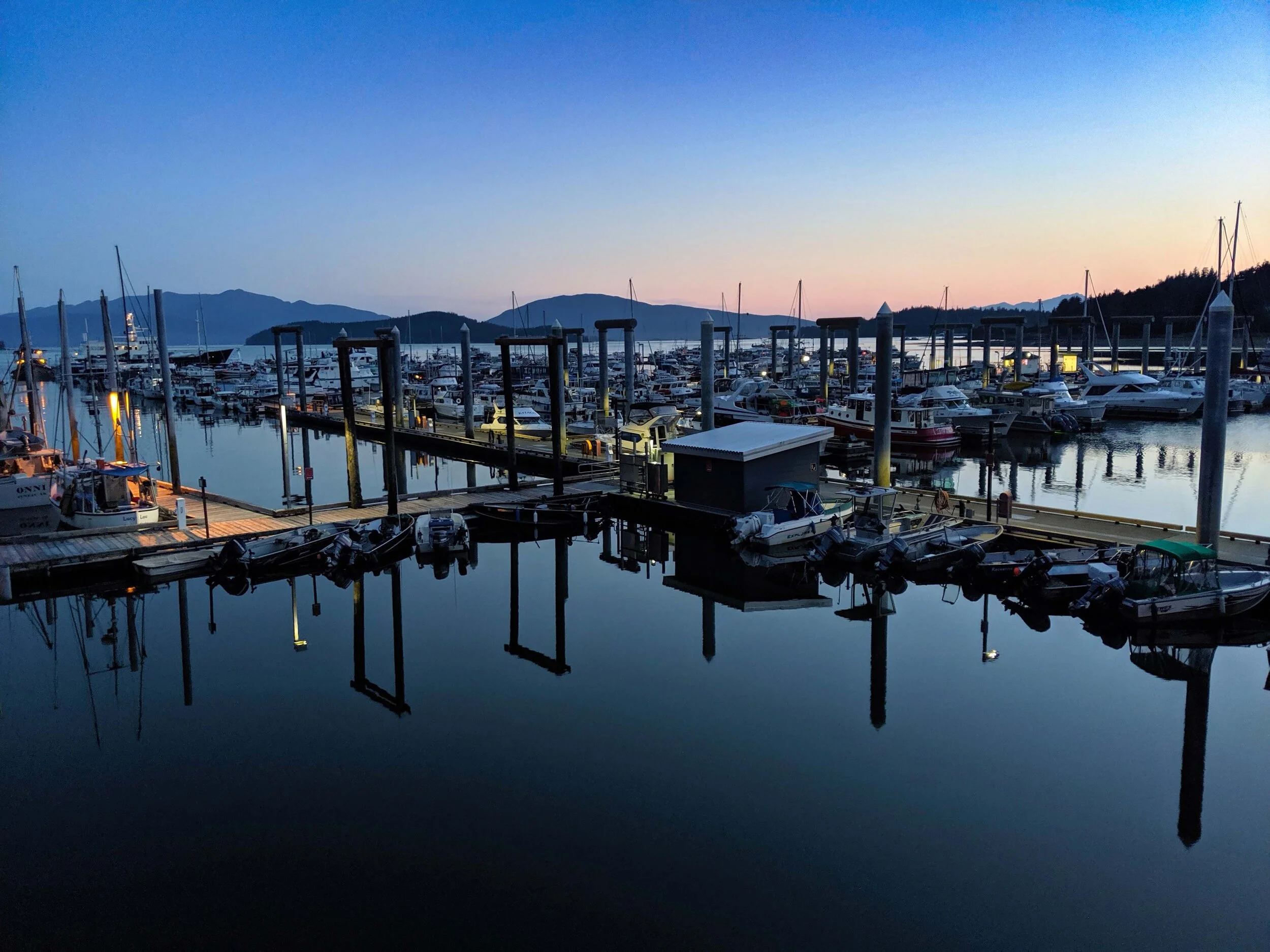
Statter Harbor (aka Auke Bay Harbor) late in the day
DIY Photography Tours
There are several photography excursions you can explore while staying in Alaska. Often times, the tours are focused on something specific such as the Northern Lights or perhaps a specific animal such as a Bear. If you have limited time and would like to give yourself the best chance to photograph something specific in Alaska, I highly recommend taking a tour or hiring a private guide.
However, if you have a few days to roam around Juneau, Alaska, I would encourage you to challenge yourself to photograph as much as you can in your time here. What’s helpful with this ‘cast your net’ approach (or taking a broad approach to photographing as much as possible), is a list of items for you to focus on. This will help get your mind thinking about items to look for when you’re out and about - and it will help you get as many great shots as possible.
Statter Harbor - One of Juneau’s beautiful harbors
Just like other cities in Southeast Alaska, Juneau has several harbors. Especially during the summer months, these harbors are hustling and bustling with commercial fishermen (& women), fishing and whale watching charters, and private boats. Every once in awhile a mega yacht will also be docked dwarfing even the biggest of commercial fishing boats (check out the short video below). While some boats have dedicated dock space (first few spaces of the harbor), most spaces at this harbor are considered ‘Transient Moorage’ meaning there’s always new boats coming and going and new things to photograph!

Walk the docks of Statter Harbor
If you have a few minutes while you’re here, I encourage you to walk through the docks photographing the details and landscape of this harbor. Most of it is made out of weathered wood and most boat captains are very friendly. Get a feel for the vibe of ‘Alaskan fishing life’ and listen to the docks as they groan against the change of the tides. If you happen to be into photography, here’s a list of items that you may want to capture while you peruse the area.
10 things to photograph at Statter Harbor
Harbor Seals (or Sea Lions): Check out the wildlife that hangs out around the harbor (some people have even spotted humpback whales from the docks!).
Commercials Buoys: If the commercial boats are in, usually they boast bright, colorful buoys that they use at the end of their fishing lines / crab pots.
Flags: Several boats (commercial and private) will have flags on them. Some of them the USA flag and other flags that add character to the ships.
Eagles: Keep your eyes open for eagles. Usually they are flying overhead, near the waters edge or perched in the gigantic pine trees that line the harbor.
Ropes: Almost every boat uses some type of ropes to connect to the floating docks. These ropes come in multiple patterns, textures and widths.
Dogs: I have met several boat captains who will take their dog out to sea.
Grundens: Usually bright orange or even a forest green, several anglers often have heavy duty rain gear that includes bib overalls and a heavy rain coat.
XTra Tuff (Brown Boots): Considered a staple to Alaskans, I would be very surprised if you did not see at least 1 pair of Xtra Tuff boots. These famous brown boots adorn even the smallest of anglers.
Mountains: If you’re facing away from the harbor and the weather is clear, check out the mountain range in the distance.
Halibut, Salmon or Crab: If you’re at the docks during the summer evenings, there’s a great chance that you’ll see an anglers catch from earlier in the day.
Did you have a chance to photograph around Statter Harbor or near Juneau? If so, we would love to see your images! Feel free to reach out on our contact page - we look forward to hearing from you!
Alaska Eagle Photography | 4 places to photograph eagles in Juneau, Alaska
If you have visited Juneau, Alaska, then you have probably spotted a few Bald Eagles flying overhead or sitting on lamp posts and have heard their distinctive cries. Their massive wing spans, powerful jaws and impressive talons all add to this bird’s allure.

Mary Parkhill photographing wildlife in Juneau, Alaska
If you have visited Juneau, Alaska, then you have probably spotted a few Bald Eagles flying overhead or sitting on lamp posts and have heard their distinctive cries. Their massive wing spans, powerful jaws and impressive talons all add to this bird’s allure.
I often receive the question of “where should I go to photograph bald eagles?” To see the most amount of eagles in the shortest amount of time (to give yourself as many opportunities to photograph these majestic eagles), then continue reading.
Based on spending my summers in Juneau, Alaska, below is a list of the best areas to photograph Bald Eagles.
Where to photograph Bald Eagles in Juneau, Alaska?
Shores of the Gastineau Channel: During low tide, Bald Eagles flock to the sides of the channel in search for treats that the sea has left behind. As the salmon runs start and as the summer season progresses, the volume of eagles increases.
Statter Harbor: In an area known as Auke Bay (north of the city of Juneau), Statter Harbor is one of the more prominent harbors. It’s home to commercial fishermen, fishing charters, whale watching and personal boats. In this area, you will often see Bald Eagles hanging around the docks and in the nearby pine trees.
Around Humpback Whales: When Humpback Whales feed, often times they churn the ocean waters and bait fish (ex. herring) will swim/float closer to the surface. Eagles will swoop in and snatch up the fish in their talons making for great action shots!
DIPAC Hatchery: When the salmon begin to run, Eagles can be found waiting around DIPAC salmon hatchery (even in the trees across the road). This area offers unique opportunities to catch eagles eating salmon along the shore - just watch-out for the anglers in the area! While in the area, at a low tide check out Salmon Creek just a few hundred yards north of DIPAC for a great vantage point of eagles preying on incoming salmon.
Bald Eagle Photographs Taken in Juneau, Alaska

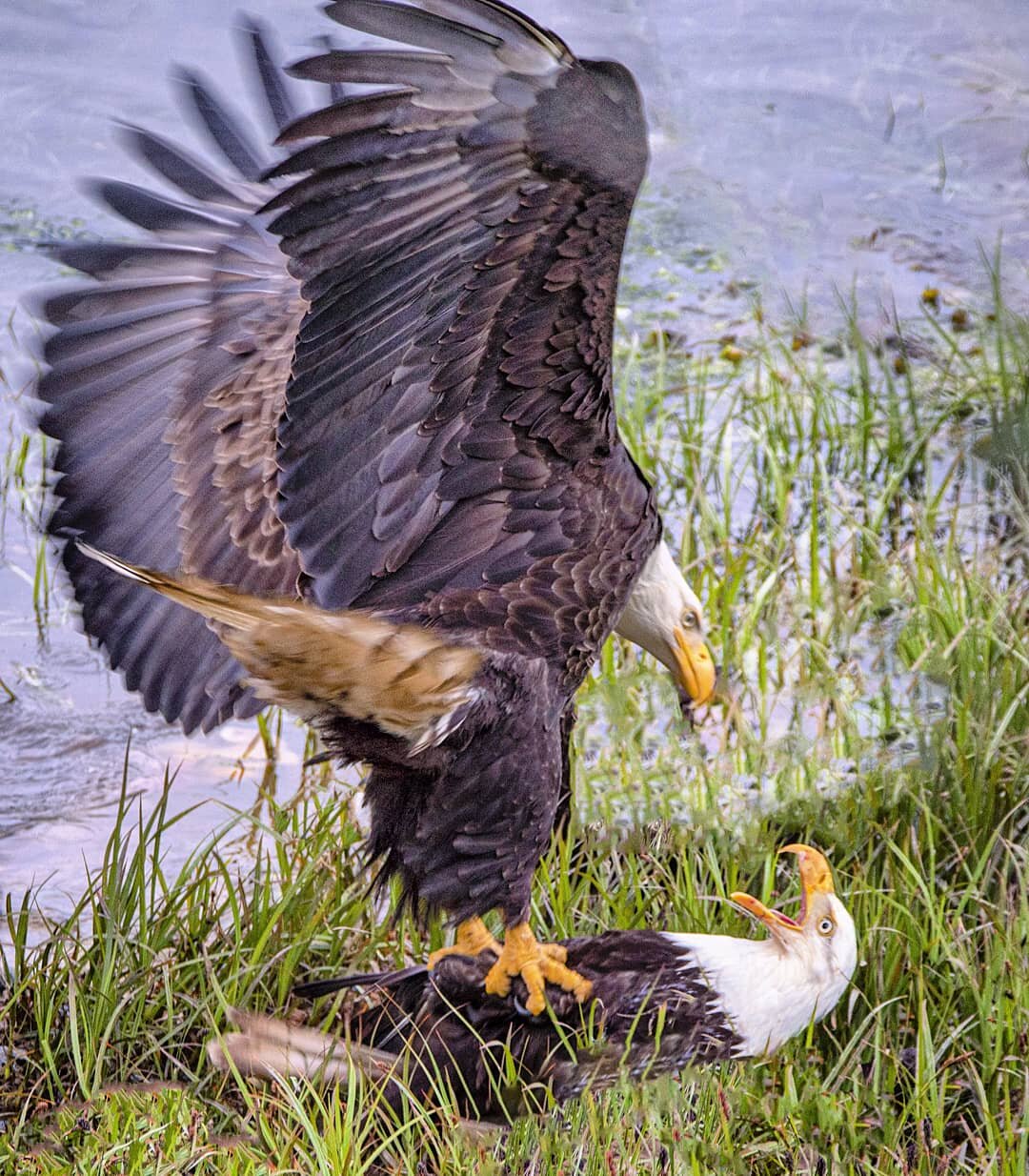
Two eagles fighting each other during a feeding frenzy in Juneau, Alaska
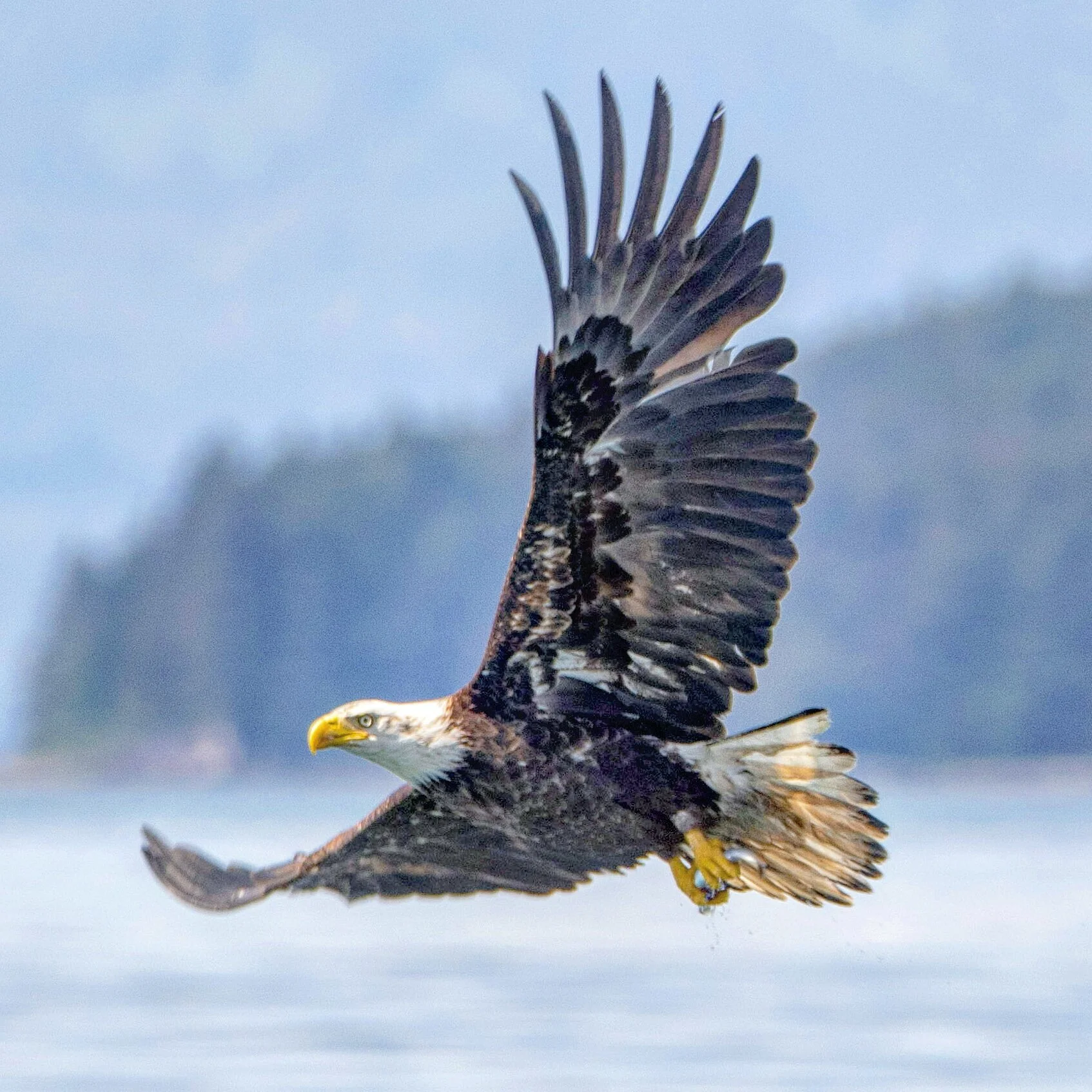
Bald Eagle’s spread wings as it takes flight with a herring in it’s talons

I captured this photo as the Bald Eagle flew directly overhead
Want to learn more about Eagles and Alaska?
Read about things to do in Juneau, Alaska
Learn about which port town makes sense for you (from a photographer’s POV)
Learn about how to bring the Alaska Lifestyle home with you

Alaska Photography Tips | Photographing Wildlife and Landscapes in Southeast Alaska
There’s so much to see, do, experience and photograph in Alaska! Over the last decade, I have been visiting this great state (mainly throughout Southeast Alaska) and have learned a few things from a photography standpoint that I would love to share with you!
Alaska Photography Tips
There’s so much to see, do, experience and photograph in Alaska! Over the last decade, I have been visiting this great state (mainly throughout Southeast Alaska) and have learned a few things from a photography standpoint that I would love to share with you! These photography tips are practical and I hope they help you with your landscapes and wildlife shots. If you have any specific questions, please let me know in the comment section or send me a message leveraging the form on the contact page.

Photography Tips for Shooting in Alaska
There’s always a weather condition or element that you are battling as a photographer in Alaska. It might be windy, rainy, foggy. or hazy The temperatures maybe chilly and frigid causing you to jitter around more than normal. Or you’re trying to photograph from a moving bus, boat or helicopter. All of these things add to the complexity of photographing the beauty and wildlife in Alaska.
Often times, I find myself with a split second to take a capture especially when photographing wildlife. I’ve taken quite a few shots that were blurry or completely off the mark. If you find you have a similar issue, below are a few things for you to keep in mind as you adventure outside and capture the wild world around us in Alaska.
Camera Gear for Alaska
In my experience, I have used my longest lens for most of my wildlife shots and even mountain top photographs. The Alaska landscape is big and even though a humpback whale is quite large, the mountains and waterways seem to dwarf the size of the whale. If you have a teleconverter, please make sure to take it as well.
If you’re unsure of which camera body to take, please take whichever one you have that offers the widest ranges of aperture, ISO, and shutter speed. Often times your shooting conditions will be less than ideal due to the weather so make sure your camera does well in low light conditions, fast moving wildlife and distance.
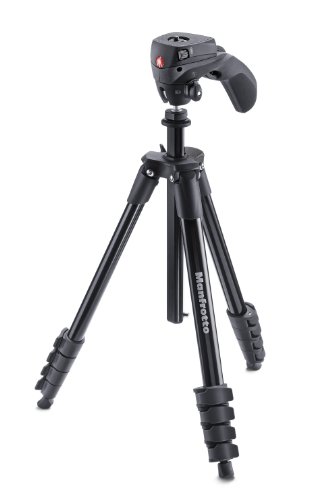
Two other camera pieces that you might find helpful are a tripod (always helpful in my opinion) and a rain cover. While a plastic bag will work as a camera cover, when it really downpours the simple investment of an actual camera cover with more solid plastic (and no accidental holes) will be worth every penny. Here are the two products that I use:
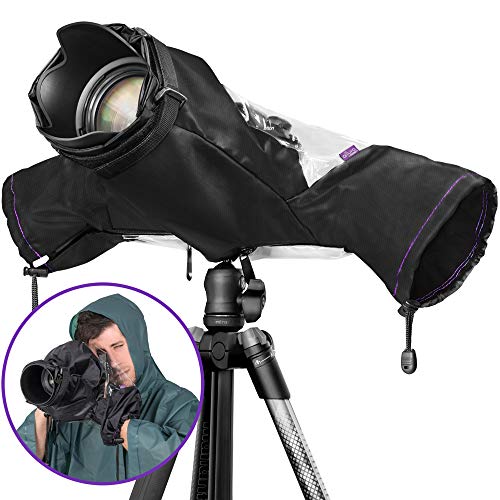
Photographer Tips for Shooting in Alaska
Patience: You know the saying, ‘Patience is a virtue’ and I have found that it could not be more critical to heed that saying than in Alaska. For example, Humpback Whales will come up for air every few minutes before they do a deep dive into the depths of the ocean. Often times, their last breath of air will be followed by their tail (fluke). If you’re patient enough, you can capture this fluke above water. Once when I was whale watching, one breeched completely out of the water! You never know what you will see if you are patient enough.
Multiple Focal Points: I started off trying to photograph humpback whales with manual focus and soon realized that for these moving creatures, trying to focus manually was extremely hard. Most DSLRs come with an automatic focus. Let the camera do the hard work for you so you can focus on things like framing, rule of thirds or even just trying to get the wildlife in the viewfinder. I have also found that the more focus points you use, the more chances you have of capturing a fast moving animal or bird. I especially found this true with photographs of diving birds.
Exercise: This seems like an odd tip but hitting the gym a few times and building your muscles for a long day of photographing is one key to successful days in Alaska. If you’re photographing wildlife, you’ll most likely be using a longer/bigger lens. Your lens is only going to be as good as how still you can keep it. Your length of time and the exposure to how many animals / birds / landscapes you have the opportunity to capture will be determined by your own endurance level. This might sound like a lame tip but its not one that most people think about until they miss the orcas swimming by because their arms are tired.
Whales: If you are new to photographing whales, consider their swimming patterns in advance. After you see a few in the water, you’ll know what I mean. For Humpback Whales, they take long, slow, deep breaths when cresting the surface of the area. On average, you’ll have 3-4 opportunities to photograph the whale’s breathing hole and then 1 opportunity to photograph it’s fluke. This might seem like a lot of time but quite often, you will need to use some of the time between when you first spot the whale to it’s final tail fluke to get closer to the whale.
Orcas on the other hand seem to come up for air more often. They travel in pods so you might see more than one dorsal fin popping above the water. Orcas tend to crest the water more often and travel faster. This means that you while you may have more opportunities to photograph their crest, they will move outside of your lens range faster. Side note - I have seen more Orcas breaching the water than I have humpback whales.
Your Alaska Photography Tips
Do you have any photography tips that you find help when photographing landscapes or wildlife in Alaska? If so, please share them in the comments below! In the meantime, check out these shots from Alaska:


Best Photography Locations in Alaska
Best Photography Location in Petersburg Alaska
One of my favorite places to photograph is located in Petersburg Alaska. It’s a tricky spot to get to because the best angles are from the Wrangell Narrows (waterway) during low-tide. For this spot, timing is everything.
Here’s an image that I’ve taken from this spot:

Petersburg, Alaska
Great Photography Location in Alaska
One of the reasons why this location is one of the best in Petersburg, Alaska is because the landscape is always changing. In addition to juggling the weather and the tides, the mouth of the Wrangell Narrows opens up to the Frederick Sound. The Sound contains deeper waters and pods of Orcas and even Humpbacks swim through this area everyday. You never know when you’ll see a whale fluke or even a sea lion.
Directions to Petersburg Alaska Photography Location
Starting at Papa Bear’s (it’s right on the main street of the town), head North towards Eagles Roost Park by foot. It will take you about 5 minutes to walk and please note that there is a slight uphill.
Once you’re at Eagles Roost Park, face the direction of the water and turn to the right. You will see the beginning of a path.
Follow the path for about :15 seconds and you’ll see stairs. Take the stairs (approximately 3-4 flights).
This is where your timing will be key. During low-tide, there will be rocks exposed. Scramble over the rocks and look down the Wrangell Narrows towards Devil’s Thumb. On a clear day, you’ll see the wonderful mountain peak.
Please note that the tide swings can be more than 14 feet (depending on the time of year, it can swing to 20+ feet).
Tip: Wear waterproof boots so you can wade into the water a bit

Directions to photography location in Petersburg, Alaska

Photographing Southeast Alaska: Wildlife, Glaciers and Landscapes
Orca Whale Nature Photography
Photographing Orca Whales and Alaska Landscapes

Orca Photograph taken in Southeast Alaska
Over the last few years, I have been fortunate enough to travel through Southeast Alaska and set eyes on beautiful vistas! The air always has a refreshing crisp to it and the scenery is grand and powerful. It’s one place in the world that feels raw and untouched. If you’ve ever cruised through Alaska or have had the opportunity to travel there, you know what I mean. If you haven’t, hopefully my photographs below will help show you what I mean.
One thing that I love about Alaska is that it is ever-changing. The environment changes rapidly under the extended summer sun and the wildlife is constantly moving. It’s exciting to see a whale fluke, an eagle in a tree or a bear scrambling up a stream for a salmon. However, as a photographer, it can also be extremely challenging.
Often times, you get one shot (no pun intended). As fast as you see a whale fluke breech the water line, it disappears below the surface. A seal that was once laying on a chunk of ice is now just a tiny head bobbing above the water. A beautiful mountain range disappears under a thick cloud of fog. For all of these reasons and more, Alaska can be a tough place to photograph but if you are up for the challenge, you will have an adventure of a lifetime.
Interested in recommendations of where to photograph during your Alaskan vacation? Send me a message here and I’ll send you a few tips and locations! Happy photographing!
Humpback Whale Nature Photography

Whale Fluke, Alaska
Southeast Alaska Nature and Wildlife Photography
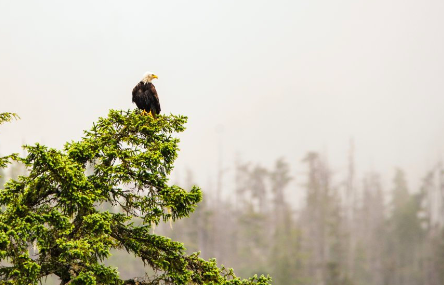
Mature Bald Eagle sitting in a tree

Orca breeching in Alaska

Crab Pot Buoy
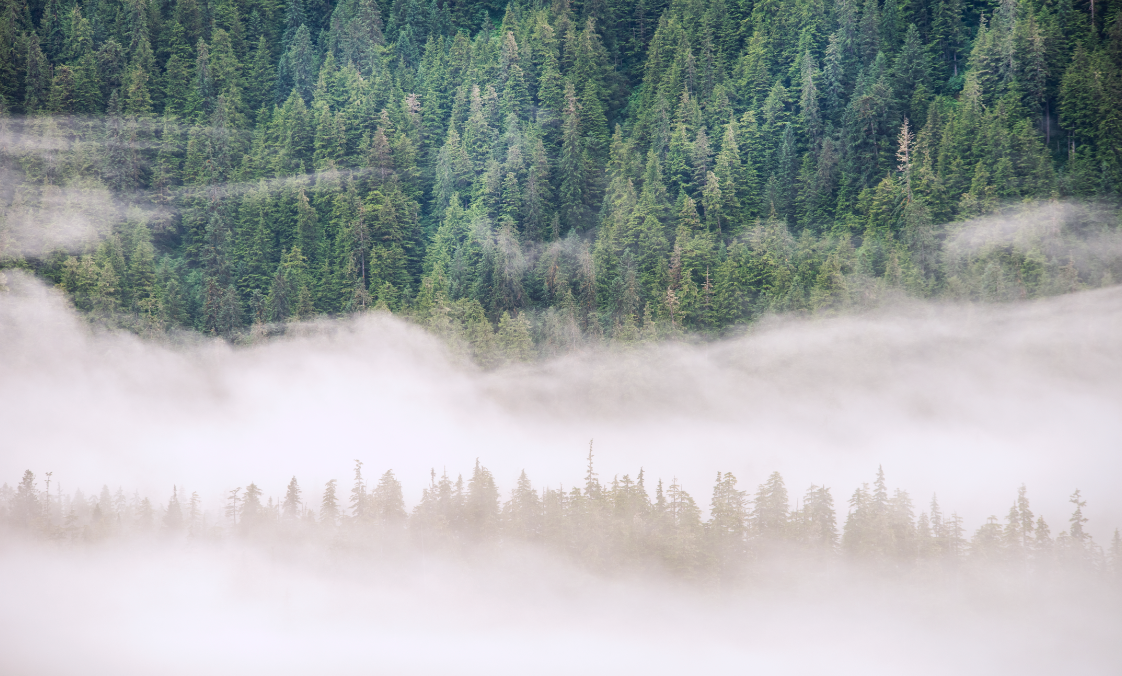
Alaska Forest & Fog
Juneau Alaska Landscape Photography
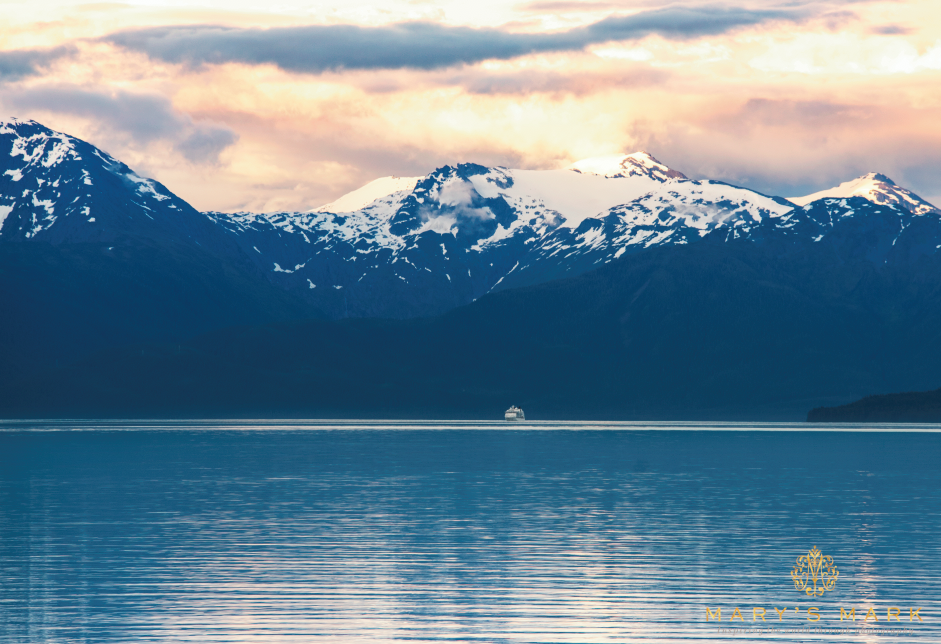
Snow capped Mountains in Alaska
Glacier Photography
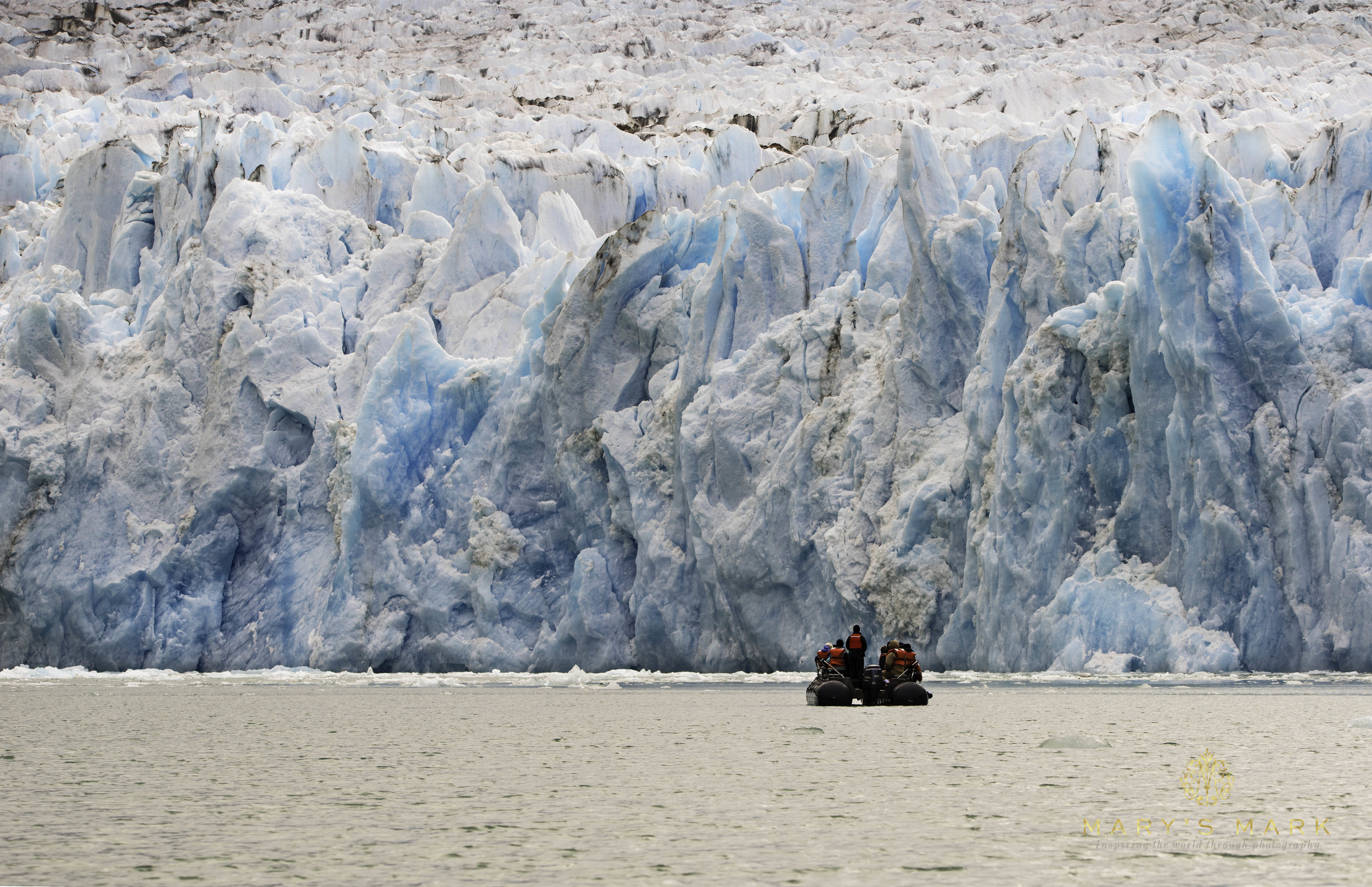
Glacier
Alaska Landscape Photography Equipment
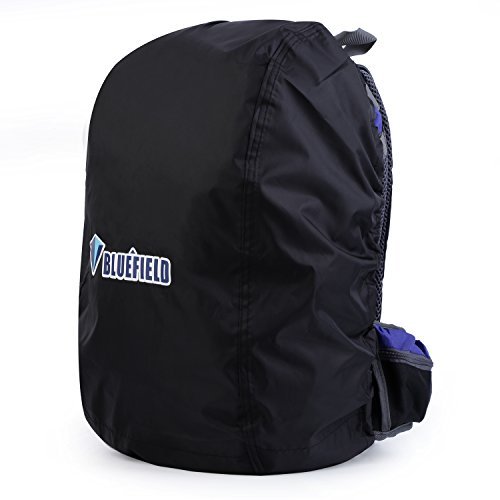
In addition to the normal camera gear I tow along with me on each trip, I decided to take two weatherproofing items to Alaska. It rained almost everyday when I was there so I’m extremely happy that I had these two items. One item was for my camera and the second item was for my backpack (I didn’t want the rest of my gear getting wet while I was hiking around). Below are the two lifesaving pieces I had with me:

I’m so glad you’re here.
This is a cornerstone of Alaska-inspired stories, photography, and small rituals - for people who want to travel, and live, with more intention.
Written from Juneau, Alaska by a photographer who lives here.